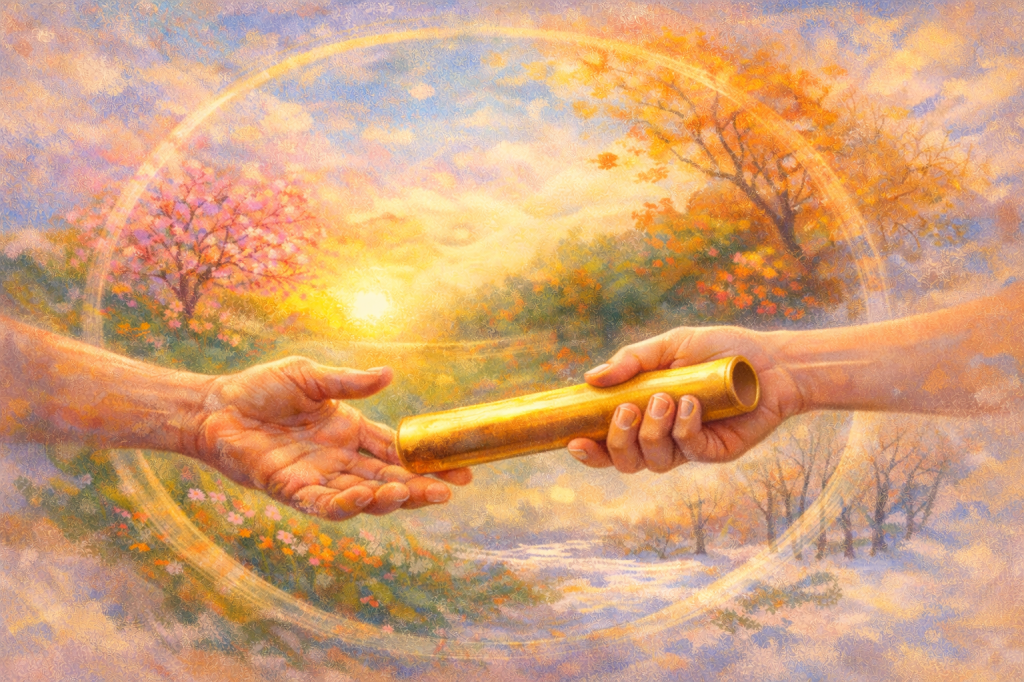
What Product Management, Democracy, & Parenthood Teach Us About Transition.
Have you ever held a position you cared deeply about, one that shaped your self-identity, only to notice your motivation shifting and your connection to your customers thinning? At first, the responsibility of the position felt like a mandate that energized you. You were entrusted by others to deliver on their behalf. But over time, that trust began to feel like expectation, quietly shaping you more than the people you were meant to serve.
I’ve witnessed this pattern play out in my career, my personal life, and in government. Authority usually begins the same way: with an opportunity granted by someone else, and trust that is earned over time as you deliver for them. But if we’re not careful, that trust can slowly concentrate into power—until it begins to distract from the original intention of the role. When we think of ourselves as stewards instead of figures of authority, it helps maintain the right frame of reference: service to our customers. And it reminds us that part of responsible stewardship is recognizing when it’s time to transition that authority to someone else.
In this post, I will explore why this shift shows up so consistently across different parts of life, and how thinking in terms of stewardship, not authority, can help us stay oriented toward the people we serve. I’ll share a simple framework that shapes how I think about product management, democracy, and parenthood. And I’ll conclude with why intentional transition is a responsibility we all shoulder: to ensure what we build continues to serve our customers beyond our season of stewardship.
Those We Serve Have the Authority
We exist to serve others in pursuit of advancing humanity. Those we serve should drive all we do as stewards using a system through which impact flows. This relationship between those served, the steward, and the respective system holds true across contexts, even as the labels change.
- In business, those served are the customers, the steward is the product manager, and the system is the product.
- In family, those served are the next generation, the stewards are the parents, and the system is the family unit that evolves over time.
- In democracy, those served are the people, the stewards are the elected representatives, and the system is government.
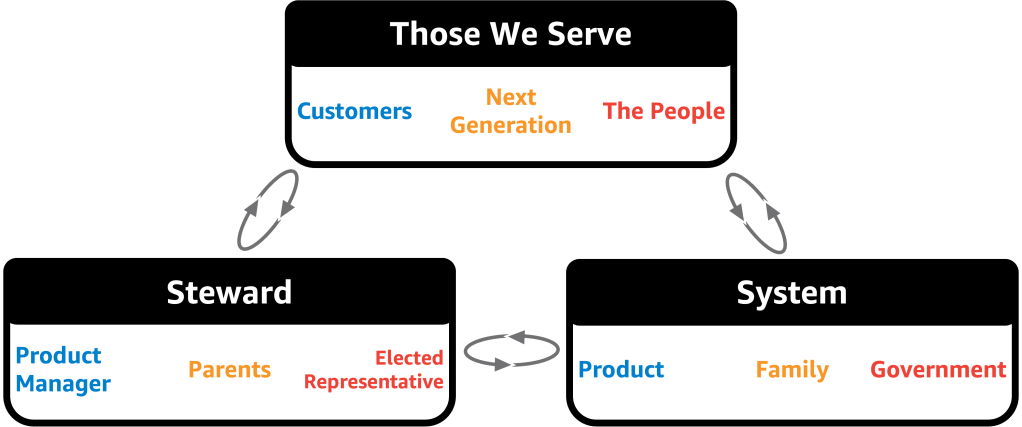
The strength of this structure comes from its feedback loops. Those we serve shape the steward by requiring them to understand evolving needs and engage directly to respond to them. The steward shapes the system by choosing which improvements to make on behalf of those served, while balancing the health and sustainability of the system itself (e.g., profit, efficiency). And the system shapes outcomes for those served through how it is used and experienced (e.g., purchases, engagement, sentiment).
When these loops stay healthy, stewardship remains legitimate. When they don’t, drift begins.
Stewardship Has Seasons
I expected stewardship to follow a simple arc: building, peaking, and declining over time. A clean, intuitive curve. But when I looked more closely—especially at firm performance relative to CEO tenure—I found something more nuanced. And once I saw it in business, I couldn’t unsee it in family and government as well.
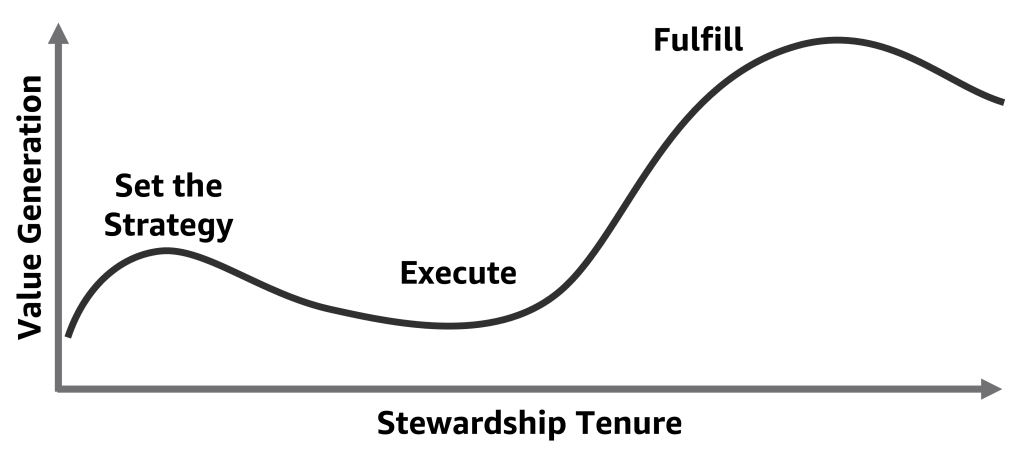
Research (reference) does suggest that staying in a leadership role too long can eventually hurt performance. But other work, including analyses summarized by Spencer Stuart (reference), reveals a more textured pattern. Firm performance often peaks during what they call the “golden years”—roughly a decade into a CEO’s tenure—after leaders work through a long middle stretch where investments are made, change is hard, and results lag effort. Reflecting on this, I realized that responsible stewardship doesn’t follow a single rise and fall. It unfolds through distinct seasons:
- Strategy Setting, when a steward is entrusted with responsibility and builds clarity and belief about what matters and why.
- Execution, when change is underway but patience is required because progress isn’t yet visible.
- Fulfillment, when those investments begin to compound and the system delivers sustained value for those it serves.
This pattern persists beyond business because it’s fundamentally human—and time dependent. In families, early parenthood is fueled by excitement as you create new humans. That’s followed by a long season of raising children into adults. You catch glimpses of who they might become, but it takes years before they begin to carry the baton themselves—forming their own families and extending the larger family system forward.
In government, new leadership brings optimism and direction that resonates with voters. But execution takes time within complex institutions, where relationships must be built, trust earned, and compromises made before meaningful outcomes can emerge.
Across contexts, the details differ—but the rhythm holds. Stewardship unfolds over time, not in moments. The most consequential impact often arrives later than we expect, after patience, trust, and persistence have had time to compound. And part of responsible stewardship is sensing when that season is maturing—and when it’s time to prepare for transition to new stewards.
Stewardship Spins a Flywheel
The most impactful stewards understand which season they’re in, and transition authority to a new steward early enough to ensure their system continues to maximize its impact for the people they serve. Stewardship is not a static role. It evolves as systems grow, people change, and the needs of those served shift over time. What creates lasting impact is not how long a steward holds authority, but how intentionally they move it forward.
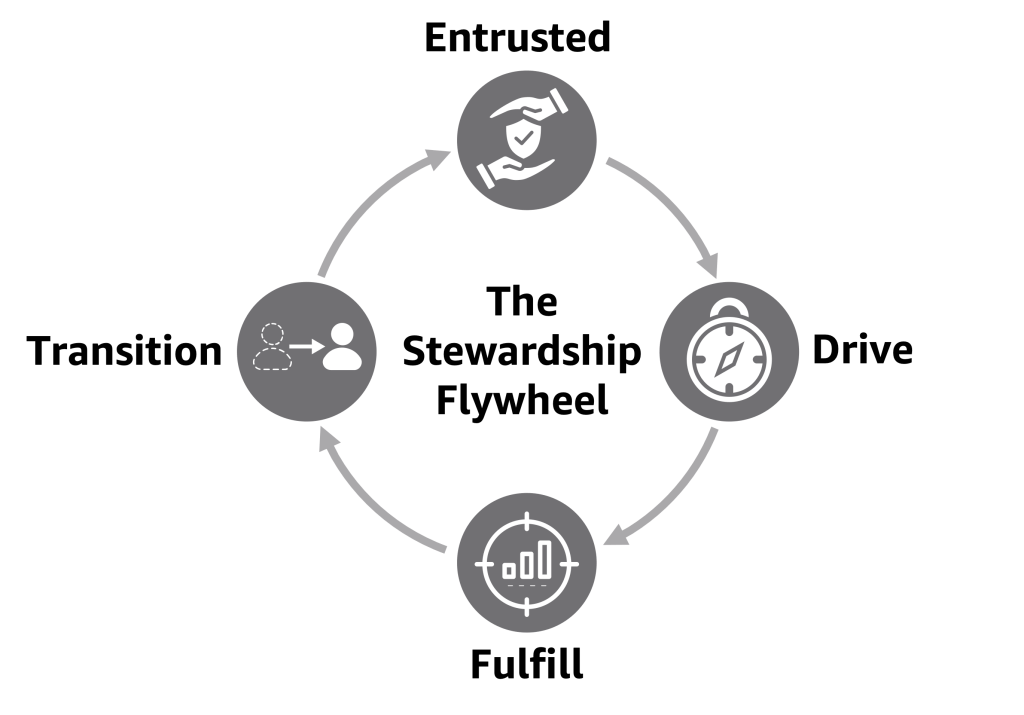
Responsible stewardship spins a flywheel: authority is entrusted, direction is driven, outcomes are fulfilled, and responsibility is transferred. Each phase builds the conditions for the next, and the flywheel remains healthy only when stewards understand where they are and intentionally progress to the next phase at the right time.
The flywheel breaks when transition is delayed. When authority lingers beyond its most effective season, stewardship quietly shifts from service to preservation. The system may continue to function; but its ability to adapt, renew, and serve diminishes over time.
Completing a Cycle is Harder than Starting One
I completed a full cycle of stewardship during the first twelve years of my career. I joined a small R&D company as a mechanical engineer, designing and testing mechatronic prototypes. We had a niche vibration sensor called Slam Stick, originally developed to quantify energy harvesting potential. Engineering customers, including ourselves, quickly began using it more broadly for prototype testing because it was simple, fast, and intentionally “quick and dirty,” just as the name implied.
I was later entrusted by a key Navy customer and our leadership team to build on that foundation and turn it into something more capable and robust, even though I wasn’t the original inventor. I drove that development into a self-sufficient product line and rebranded it as enDAQ (engineering data acquisition). Over time, that program leadership grew into building a small business unit serving everyone from the world’s largest engineering firms to single-person consultants, all relying on an expanding hardware and software platform, fulfilling the original vision.
But getting a system to work isn’t the end of a steward’s cycle; it’s the moment when staying begins to carry more risk than leaving.
I set a new, bolder vision: evolving enDAQ from a ~$3M business into a $20M+ one by moving beyond test-and-measure into condition-based maintenance, and eventually into active controls. I invested in wireless communication, cloud reporting, and sought to leverage adjacent technologies across our parent company to enable that shift. And slowly, I realized something uncomfortable: I didn’t have the patience, or the energy, to wait the decade it would likely take to see that vision through.
That was the moment I knew it was time to transition stewardship to someone else.
Leaving was the hardest decision of my career, and possibly my life. I had accumulated trust with customers, authority within the organization, and high expectations from a senior Leadership team of our parent company who believed in me to transform their innovation strategy. Walking away from that was painful. But it was also the right decision for the company, which I still follow with pride as it continues to succeed, and for me, as I prepared to begin a new cycle of stewardship at Amazon Robotics.
Recognizing the Next Season and Choosing to Step Into It
My first three and a half years at Amazon have been punctuated by a major event in my personal life: the birth of our fourth child. Looking across both my career and my family, I can now see that I’m stepping into a new season of stewardship, one defined less by discovery and more by driving.
Much of my early time at Amazon was spent earning trust within the organization and with our customers: the operators of the Sub Same Day network. That initial season takes patience. It requires listening, understanding the system as it truly operates, and helping others see not just what could improve, but why it matters for those we serve. In my case, that vision centers on enabling buildings that are highly labor-efficient, fast, and dense.
Now, I feel the shift. The work is no longer primarily about framing the vision; it’s about driving delivery. That means translating intent into execution, incrementally realizing near-term benefits for customers while learning from real building operations to refine and improve future designs. Robotics development cycles are long, and it will be years before we fully fulfill this vision. That’s not discouraging. It’s clarifying. I know the season I’m in, and there is meaningful work ahead.
I’m experiencing a similar transition at home. As our fourth child approaches eighteen months, I’m coming to terms with the fact that she is our last. The season of having children has ended, and the season of raising them has fully arrived. That shift is both sobering and energizing. It doesn’t lessen the responsibility—it deepens it. The work now is to invest fully in helping our children grow into independent adults, building on the foundation we’ve already set and the family culture we’ve worked to establish.
I anticipate that this stewardship cycle in my career will eventually align with my cycle as a parent, with both moving toward transition around the same time. As my children approach adulthood, I expect to be looking to begin a new cycle of stewardship in public life—not necessarily as an elected representative, but by helping representatives and government institutions stay focused on those we serve, rather than preserving power.
Mechanize Transitions for Elected and Appointed Representatives
I’ve experienced these cycles of stewardship at home and in my career, like I suspect many of us have. But when I look at our government institutions, it feels like the cycle turns far more slowly than it should and loses touch with the people they are tasked with serving.
So I gathered data on total tenure in the House, Senate, and Supreme Court to see whether that intuition shows up in practice.
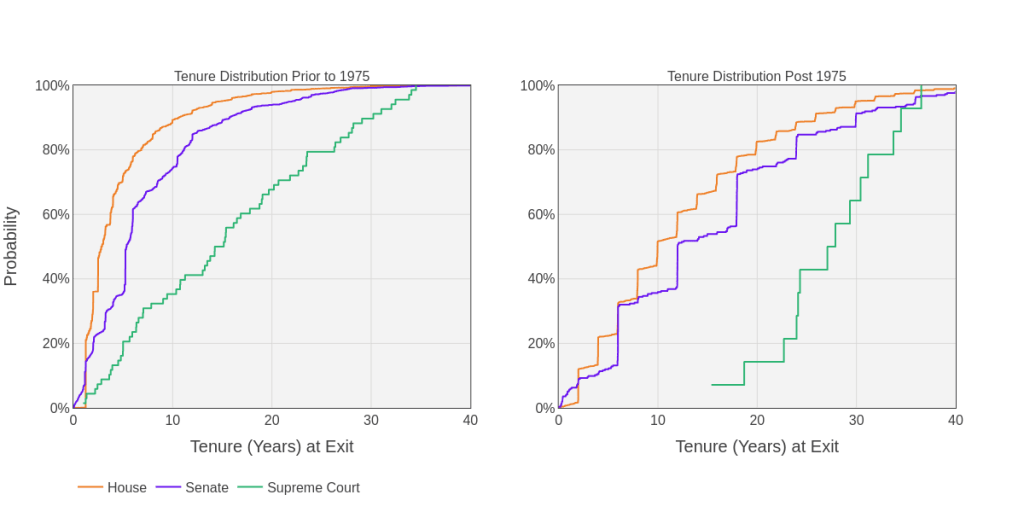
I expected tenures to be long—and to trend longer in the modern era. What surprised me was how gradually the distribution transitions into very long service. There’s no sharp point where staying becomes rare. Instead, the system eases steadily into decades-long stewardship.
At first, this looks healthy. Only about 10% of House members and roughly 30% of senators serve a single term. The median House member serves five terms (10 years), and the median senator serves two terms (12 years). That aligns with what we’ve already seen: stewardship takes time. Trust, momentum, and impact compound over multiple cycles.
But further out in the distribution, the pattern changes. One in five representatives serves at least ten terms (20 years) in the House or four terms (24 years) in the Senate. At the 90th percentile, tenure stretches to thirteen House terms (26 years) and five Senate terms (30 years).
What stands out isn’t that long service exists—it’s that nothing in the system meaningfully encourages transition once authority is established. As tenure extends, the incentives overwhelmingly favor staying. Over time, this makes it harder for stewards to remain closely connected to the evolving needs of the people they serve, even with the best intentions.
If stewardship is seasonal, then transition shouldn’t depend on self-restraint alone. It should be supported by system design. Without mechanisms that make renewal the natural next step, authority will continue to accumulate well past its most effective season.
Democracy Needs Term Limits
From the beginning, American democracy understood the importance of transition. George Washington set the precedent by stepping away from the presidency after two terms, signaling that leadership was a responsibility held for a season—not a role to be occupied indefinitely. That principle was later formalized, but only for one office.
If stewardship is seasonal, then democracy needs mechanisms that make transition predictable and honorable, rather than an impossible personal decision. Term limits are one such mechanism—not as a judgment on individuals, but as a design choice that keeps authority aligned with those it serves.
The data supports this. Median tenures in Congress—about ten years in the House and twelve in the Senate—align well with productive seasons of stewardship, where trust and momentum compound. But beyond that, the system offers little signal that it’s time to hand authority off. Persistence is rewarded; renewal is left to self-restraint.
Term limits introduce clarity. They don’t prevent service; they shape it—marking transition as an achievement, not a failure (for example, roughly a dozen years of cumulative service in Congress). In institutions with no natural transition at all, like the judiciary, long but finite terms could preserve independence while restoring predictability and renewal.
Term limits don’t solve every problem. But they do one thing well: they shift transition from a personal dilemma into a shared expectation—so stewardship remains focused on those we serve, long after any one season ends.
Practice Stewardship Intentionally
Stewardship asks more of us than commitment alone. It asks for awareness—of the season we’re in, the needs of those we serve, and the health of the system entrusted to us. Sometimes that means stepping forward with energy and conviction to drive change. Other times it means fulfilling a vision patiently. And sometimes, it means recognizing that the most responsible act is to prepare for transition, even when staying would be easier.
Transition isn’t retreat. It’s choosing the role that best serves the system and the people who depend on it, rather than the one that best preserves our identity or authority. My hope is that we each adopt this mindset in our personal and professional lives, confident that our government can reflect the same wisdom we apply elsewhere: that stewardship is seasonal, that transition is a responsibility, and that systems thrive when they remain closely connected to the people they serve.
So as you step away from this post, consider where you are in your own stewardship cycle, professionally and personally. Is the system around you asking you to step forward with energy, or to prepare the way for someone new? And beyond government, what would change if more of us carried this way of thinking into how we lead, parent, build, and serve, season by season, with intention that remains focused on those they serve?
 hanly hopes
Leave a comment